
Advanced Water Purification Process
The Greenspot Recharge Project includes multiple treatment process upgrades and uses the best available technology to produce almost 162 million gallons, or 500 acre-feet, per year of purified water. That's equivalent to what 2,700 average households in the Big Bear Valley use each year.
These upgrades, including ultrafiltration, reverse osmosis, and ultraviolet (UV) disinfection, will produce purified water that meets or exceeds all state and federal water quality standards. Purified water from the Big Bear Area Regional Wastewater Agency (BBARWA) treatment plant will travel to new recharge basins in the Erwin Lake area. There, it undergoes additional, natural filtration as it slowly filters down through layers of soil and travels northwest to existing municipal wells, helping to replenish the Big Bear Valley's groundwater basin.
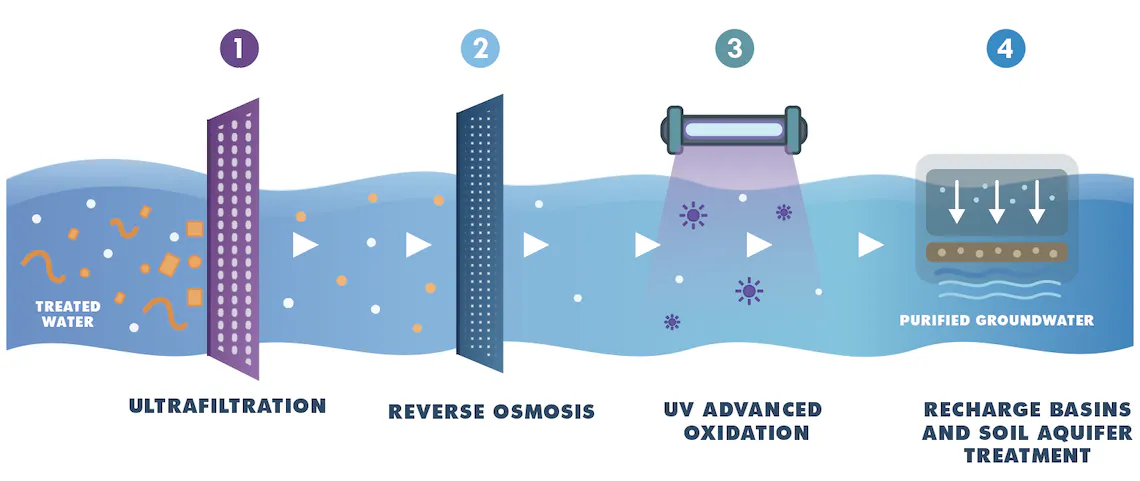
How it Works: Process Descriptions
1. Ultrafiltration: Water that has already gone through three steps of treatment at BBARWA’s existing plant is then pumped through membranes with pore sizes so small that suspended solids, bacteria, and most viruses cannot pass through.
2. Reverse Osmosis: Water is pumped under high pressure through membranes with even smaller pores that remove contaminants including pesticides, salts, heavy metals (like lead), forever chemicals (PFAS), and pharmaceuticals.
3. UV Advanced Oxidation: Intense ultraviolet light is combined with chlorine to create a chemical reaction that destroys any remaining viruses and contaminants, creating purified water.
4. Recharge Basins and Soil Aquifer Treatment: Purified water is placed into recharge basins that look like large ponds. It undergoes additional natural filtration as it slowly filters down through layers of soil and replenishes the groundwater basin.
